


Renewed clashes broke out yesterday as self-help organizations against the forced house demolitions in Miaoli County’s Dapu Borough (大埔) protested outside the new Ministry of Health and Welfare in Taipei during a visit by President Ma Ying-jeou (馬英九), leading to the arrest of a National Chengchi University professor and another demonstrator.
Four houses in Dapu were demolished by the Miaoli County Government on Thursday last week to make way for a science park project, despite the protests of students, academics and civic group activists questioning the legitimacy of the local government’s actions.
More than 100 people demonstrated in front of the Presidential Office, urging the government to apologize and return the land to its owners before Aug. 18, which would mark the one-month anniversary of the houses being torn down.

Photo: CNA
Taiwan Rural Front spokeswoman Frida Tsai (蔡培慧) said the central government had connived with the county government, and their brutal actions not only demolished the houses, but also the public’s last bit of faith in the government system.
The groups said the county government even asked one of the homeowners to pay a disposal fee of about NT$242,000 — approximately the same amount as the owner received in compensation for the land expropriation.
They said the request laid bare the “brutal and intentional bullying” nature of the Miaoli County Government.
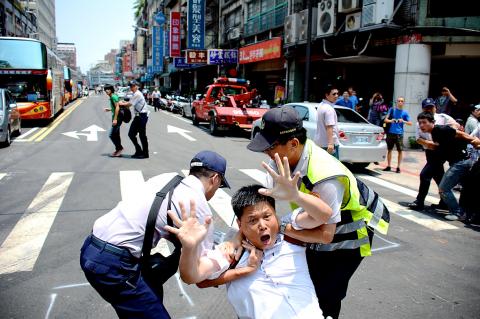
Photo: J. Michael Cole, Taipei Times
Peng Hsiu-chun (彭秀春), one of the four homeowners, held up objects salvaged from the rubble of her home.
“I don’t want to stand against the government. I only want a home — a home that I worked hard for. I paid my taxes, but my home is gone now,” a sobbing Peng said.
Tsai said if the government does not apologize to the people, return their land, investigate possible corruption surrounding the project and immediately amend the Land Expropriation Act (土地徵收條例) to protect the public’s rights, they will call for more people to “dismantle the bandit government.”
Several of the demonstrators later went to Tacheng Street, where Ma was attending the opening ceremony for the new ministry.
“[You] knock down houses in Dapu today; [we] tear down the government tomorrow,” National Chengchi University professor Hsu Shih-jung (徐世榮) sang as black official state cars drove by the crowd on the sidewalk.
Hsu, who was shouting the slogan adopted by the protesters, was immediately pulled away by police officers, who said he had violated the Public Safety Act (公共危險罪).
Although he repeatedly said that he had not broken the law, Hsu was dragged to a police car and taken to a police station by several officers.
As he was taken away, other protesters surrounded the police and shouted “use of excessive force.”
Hung Chung-yen (洪崇晏), a student from National Taiwan University, was also taken away by police for alleged violations of the act and malfeasance after he fell to the ground and injured his head during clashes with police.

The National Chungshan Institute of Science and Technology yesterday showcased its locally developed variants of the Vision 60 robotic patrol dog, which it plans to deploy on the nation’s outlying territories in the South China Sea. The variants were produced under the Joint Lab project — created by the institute and domestic companies — and assembled with domestically produced motors, lenses and artificial intelligence (AI) systems alongside licensed tech from the US, Missile and Rocket Systems Research Division deputy director Jen Kuo-kang (任國光) told the media event at a military base in Taipei’s Dazhi (大直) area. Taiwan has built up its strengths

RIGHT DIRECTION: Taiwan’s efforts to prevent forced labor include a proposal to ‘fully prohibit’ employers from withholding workers’ documents, an official said Taiwan is to establish a mechanism to restrict imports of goods linked to forced labor, the Executive Yuan said yesterday, after the US proposed imposing additional tariffs on Taiwanese goods over labor concerns. “The Ministry of Labor and the Ministry of Economic Affairs are to establish an interministerial review procedure,” Executive Yuan spokesperson Michelle Lee (李慧芝) said at a news briefing in Taipei. “The government is to use the Foreign Trade Act [貿易法] as the legal basis to restrict imports of goods produced with forced labor” and bring its supply chain governance more in line with international standards on human rights, resilience

NOT IMMEDIATE: Taiwan has a chance to appeal the proposed 10 percent tariff before it starts, while other countries face a 12.5 percent tariff from the trade office Taiwan is among 60 economies determined by the US to have failed to impose or enforce a ban on the importation of goods produced with forced labor, according to a notice released on Tuesday by the Office of the US Trade Representative (USTR), which proposed imposing an additional 10 percent or more tariff on them. The USTR in a statement said that following an investigation, it had determined under Section 301 of the Trade Act of 1974 that the failure of the 60 economies to impose and effectively enforce a prohibition on the importation of goods produced with forced labor is

TIT-FOR-TAT: The US allegedly revoked the visa of a Chinese national working at Xinhua News Agency in the US in response to Beijing’s expulsion of Vivian Wang The Presidential Office yesterday condemned China for expelling a New York Times correspondent from Beijing following the newspaper’s interview with President William Lai (賴清德), saying the move highlighted Beijing’s suppression of press freedom and its threat to international news media. Taiwan has noted a series of recent incidents in which Beijing used similar tactics to “threaten and pressure international media outlets and journalists,” Presidential Office spokeswoman Karen Kuo (郭雅慧) said in a statement. “This concerns not only press freedom and freedom of expression, but also the safety of journalists, and Taiwan and relevant partners are paying close attention to the situation,” she


 RSS
RSS